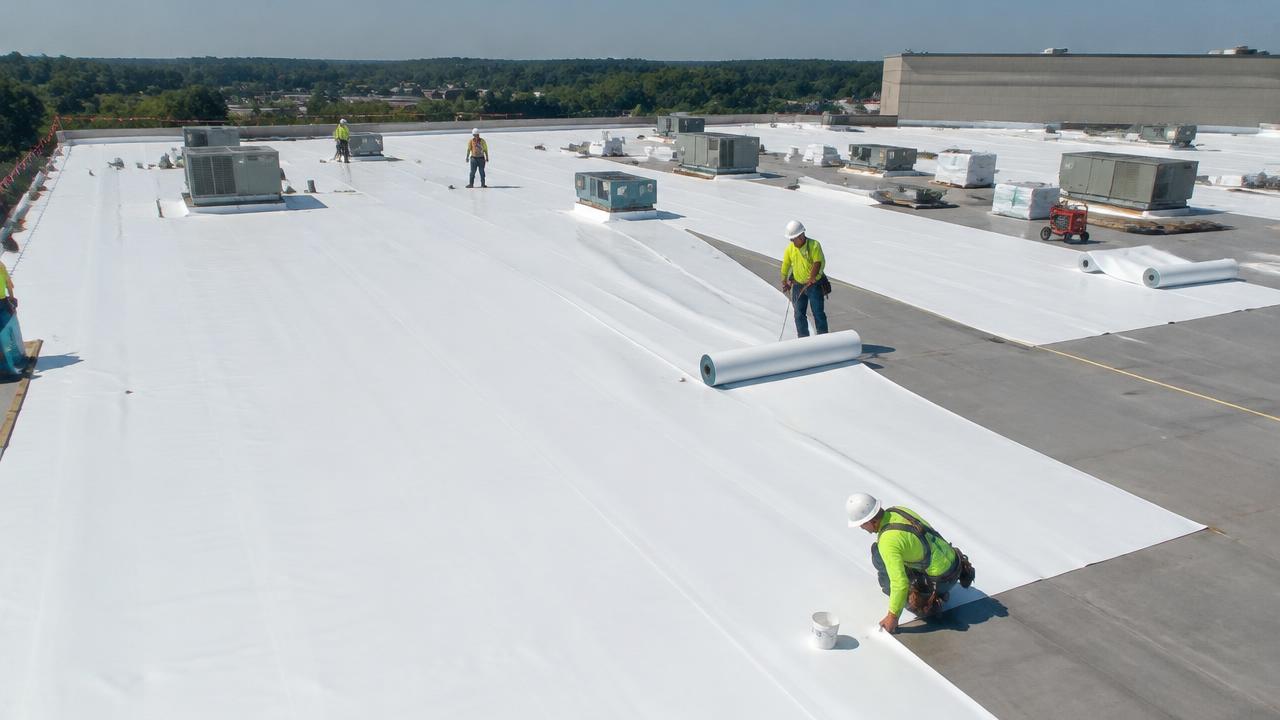
Choosing a membrane for a commercial flat roof? Compare TPO, EPDM and PVC, how each is attached and seamed, and how to plan an installation with less disruption to your building.
Most low-slope commercial roofs today use a single-ply membrane: TPO, EPDM or PVC. All three can perform well when correctly designed and installed, but they are not interchangeable for every building.
This guide gives building owners and managers a plain-language comparison and an overview of how installation works. It does not list prices; commercial roof costs depend on the building, the system specified and local labor, so request written proposals after a roof survey.
TPO membrane
TPO (thermoplastic polyolefin) is a widely used white or light-colored membrane. Its seams are welded with hot air, which creates a fused seam rather than a glued one.
- Reflective surface can help reduce heat gain on sunny roofs.
- Heat-welded seams; quality depends heavily on installer skill and weather during welding.
- Often mechanically fastened or adhered over insulation boards.
Related service:Commercial roofing →
EPDM membrane
EPDM is a synthetic rubber membrane, usually black, with a long track record on commercial roofs. Seams are joined with tapes and adhesives rather than heat welding.
- Flexible and available in large sheets, which can mean fewer seams.
- Can be fully adhered, mechanically attached or ballasted with stone or pavers.
- Black surfaces absorb more heat; white EPDM options exist.
Related service:Flat roofing →
PVC membrane
PVC is another heat-welded thermoplastic membrane. It is often considered for roofs exposed to grease, oils or certain chemicals, such as restaurants, because of its chemical resistance.
- Heat-welded seams similar to TPO.
- Frequently chosen where rooftop exhaust or chemical exposure is a concern — confirm with the manufacturer for your conditions.
- Reflective light-colored surface options.
How a commercial roof installation works
A professional proposal should explain each step and how the building stays protected and open during the work.
- Roof survey and, where needed, core cuts or moisture scans to judge the existing roof and insulation.
- Decision on tear-off versus recover, based on codes, wet insulation and the number of existing roofs.
- Installing insulation, cover board and drainage improvements such as tapered insulation for ponding areas.
- Attaching the membrane, seaming, then flashing curbs, HVAC units, drains, walls and edges.
- Manufacturer inspection where a system warranty is offered, then closeout documents.
Related service:Commercial roofing →Roof inspection →
Questions building owners should ask
Ask every bidder the same questions so proposals can be compared fairly.
- Which membrane, thickness and attachment method are specified, and why for this building?
- Is the contractor approved by the manufacturer to offer the warranty proposed?
- How will the crew handle tenants, deliveries, noise and rooftop equipment during the work?
- What happens if wet insulation or deck damage is found after tear-off?
- What routine inspections and maintenance does the warranty require?
Related service:Roof maintenance →
Find help connecting with an independent roofing contractor
Planning a new commercial roof? Call us to ask about connecting with an independent commercial roofing contractor in your area for a roof survey and written proposal. We share your request with one contractor at a time and never sell your number. Contractor availability varies by location.
Related service:Commercial roofing →
Frequently asked questions
Sources and further reading
This article is general information, not professional advice. Conditions, codes and requirements vary by location — always confirm details with a licensed, insured contractor in your area.